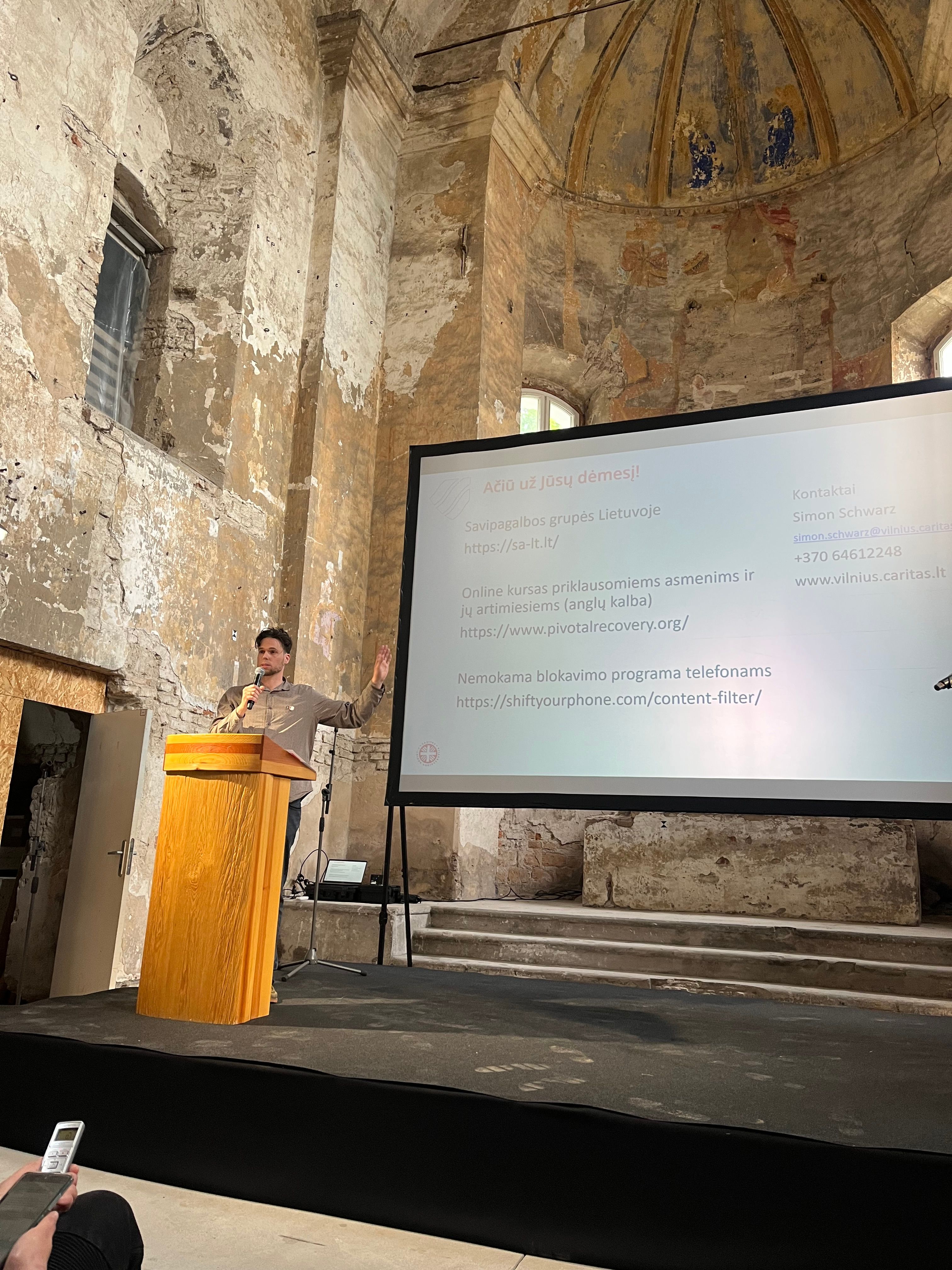
Jovitos Tautkevičiūtės nuotr.
Pornographic websites consistently rank among the most visited sites both worldwide and in Lithuania. Various statistics suggest that around 95% of men have viewed pornography at least once. But can we really say this is not a problem—that it is simply a matter of personal freedom and individual choice?
It is important to recognize that approximately 5% of people who consume pornography struggle with Compulsive Sexual Behavior Disorder (CSBD). During the World Congress on Apostolic Mercy, addiction counselor Simon Schwarz explained what this disorder is, how it affects individuals, and how family members and friends can support those who struggle with it.
What Does This Mean for Those Affected?
Simon works primarily with men who seek help because they can no longer control their sexual behavior. They experience intense and recurring sexual urges, impulses, and behaviors that feel impossible to manage.
In many cases, pornography use that began as an occasional activity—perhaps once a month—gradually escalates until it consumes six to eight hours a day, often at the expense of work, family time, and sleep.
Of course, if someone freely chooses a behavior and experiences no negative consequences, that is one thing. However, Simon says the people who come to him are those whose lives have been profoundly affected by their compulsive behavior. Marriages fall apart, jobs are lost, and thousands of dollars are spent on pornography or sexual services.
Many seek help only after experiencing the painful consequences of these behaviors. Their lives become increasingly unmanageable and hopeless, yet they find themselves unable to stop. These are some of the hallmark signs of the disorder: loss of control, significant distress, feelings of hopelessness, and continued behavior despite serious negative consequences.
How Does It Begin?
Why do nearly 5% of the population struggle with this disorder? Why has the problem become more pronounced over the past fifteen years?
Simon pointed to three key factors that drive pornography consumption: affordability, anonymity, and accessibility. The internet has dramatically amplified all three.
In Lithuania, children are first exposed to pornography at around 12 or 13 years old. Simon regularly meets young men who have not yet turned twenty but report struggling with this issue for nearly a decade.
“The younger someone starts, the more likely they are to become hooked,” Simon explains. “During adolescence, the brain is still developing and is highly adaptable. Unfortunately, it is also the ideal time to develop an addiction.”
Social media has also contributed to the problem. In one study, researchers created TikTok accounts representing 13-year-old users and found that after only ten minutes of use, the platform began recommending sexually explicit content.
Pornography is appealing because it often serves an emotional function. It can provide temporary relief from anxiety, stress, loneliness, or painful memories. For those who have experienced trauma, pornography may become a way to distract themselves from difficult emotions and intrusive thoughts.
In some cases, pornography and compulsive sexual behavior create a sense of connection, boost self-esteem, or even provide the illusion of being loved. Simon notes that pornography often becomes a coping mechanism during periods of crisis, such as experiences of bullying or social rejection.
However, he emphasizes that this is not a healthy way to regulate emotions.
“Pornography and sexual behavior can be incredibly powerful tools for managing our emotions and feelings,” Simon says. “But they come at a high cost. We end up running away from problems and emotions that we don't want to face.”
The Illusion of Relationship
A discussion following the lecture raised another important question: Does pornography contribute to the growing epidemic of loneliness?
Simon believes it does. Pornography often makes real relationships more difficult because it creates unrealistic expectations about sex and intimacy.
Pornographic films portray actors who are constantly happy, attractive, and passionately engaged in sexual activity. Real relationships are far more complex, and real-life intimacy is not always glamorous or intensely passionate.
When pornography becomes a person's primary source of information about relationships, it can create unrealistic standards for both sex and partnership. On one hand, young people may begin to question themselves: Am I attractive enough? Am I desirable enough? Will I be able to satisfy my future partner?
On the other hand, pornography can appear to satisfy the need for connection, making genuine relationships seem overly complicated, demanding, and emotionally risky. Building a real relationship requires vulnerability, commitment, and investment—qualities that pornography does not require.
What Can Be Done?
Drawing on his counseling experience, Simon offered several practical recommendations for those seeking freedom from compulsive sexual behavior:
- Be honest with yourself. The hardest step is admitting that the situation is no longer under your control. It is also the most important one.
- Talk about the problem. Recovery often begins when secrecy ends. Bringing the struggle into the open makes change possible.
- Limit access. Use technology creatively by installing content-filtering software and other accountability tools to reduce exposure and temptation.
If these measures are not enough, Simon strongly encourages seeking professional help.
“It may be difficult to overcome this on your own,” he says. “If nothing changes, the problem is likely to get worse.”
Based on his counseling experience, Simon warns that giving up pornography can be painful. He compares the process to grief because pornography often functions like “a loyal friend” that has provided comfort during times of distress.
Pornography and the Church
When discussing the Church's role in addressing this issue, Simon emphasized the need for more open conversations about sexuality.
The Church must not only teach the value of chastity but also acknowledge how difficult living chastely can be. It must also begin talking with children about sexuality before they encounter pornography online.
For those already struggling, Simon stresses that shame is not the answer.
“We need to understand that people who struggle with sexual issues are already carrying a tremendous amount of shame,” he says. “We do not need to add to it. That will only push them away.”
Instead, he encourages Christians to help people receive God's mercy for their sexual sins.
“I often meet men who feel that Christ's sacrifice on the cross is no longer enough to forgive them,” Simon explains. “The Church's mission is to proclaim that Christ's sacrifice is enough.”
At the same time, Simon acknowledges that the Church itself has not been immune to sexual sin.
“The Church has made serious mistakes when it comes to sexual misconduct,” he says. “Lithuania is not unique in this regard. We must protect victims, listen to them, and take their stories seriously.”
The Apostle Paul addressed sexual immorality in his letters to the early Church, reminding believers that this is not a new struggle. It remains an ongoing challenge requiring vigilance, humility, and accountability.