Deividas Švenčionis
The Sixth World Apostolic Congress on Mercy officially opened in Vilnius, bringing together pilgrims, clergy, and lay faithful from across the globe. Participants traveled from countries including Poland, the United States, Argentina, Kuwait, Myanmar, Pakistan, and even the remote Pacific islands of Wallis and Futuna. The opening ceremony followed the city’s Corpus Christi celebrations, during which approximately 7,000 Catholics joined a Eucharistic procession through the streets of Vilnius.
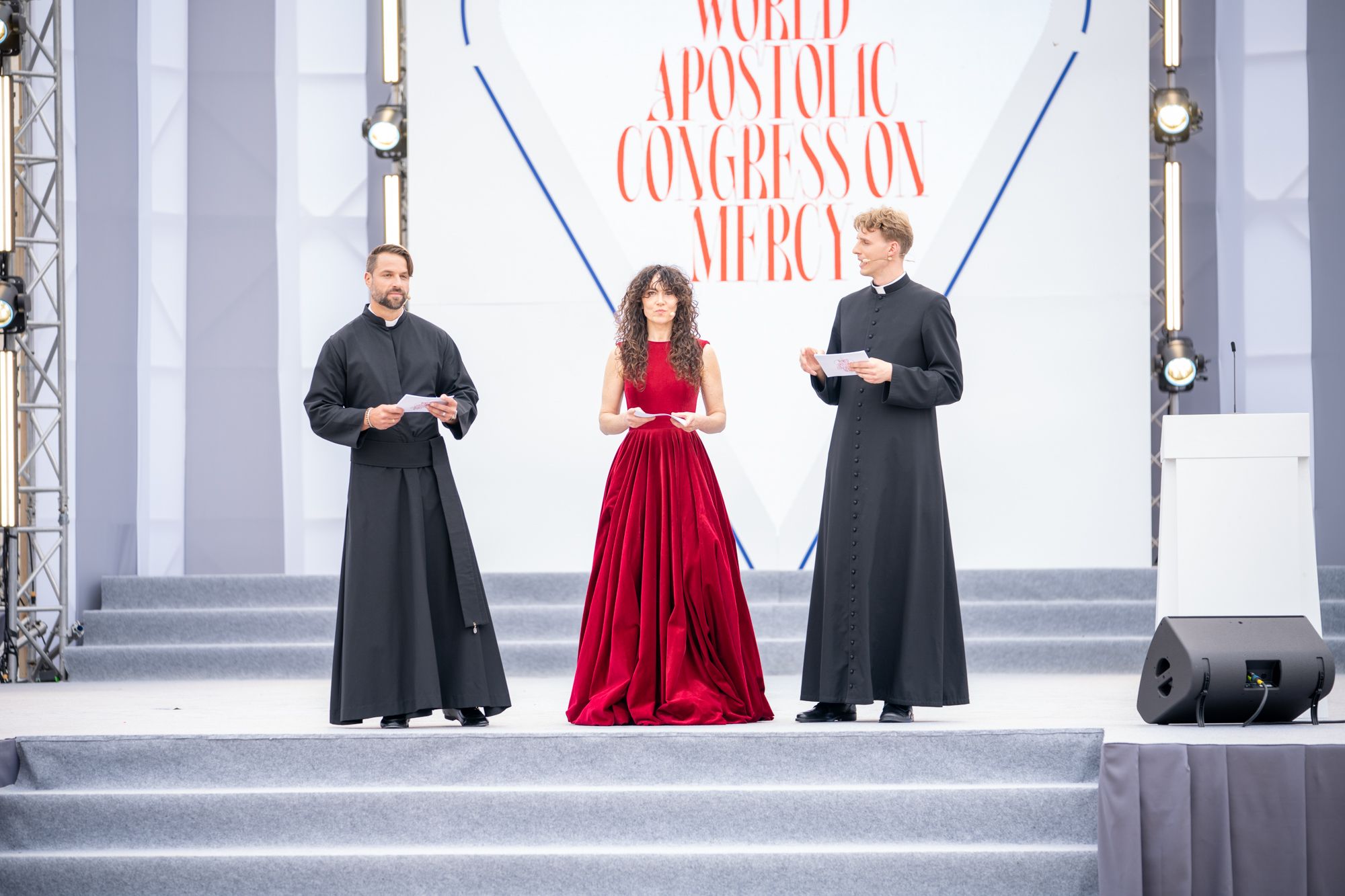
The event began with a warm welcome from the hosts, Fr. Lukas, Fr. Linas, and Dalia, who highlighted the significance of this international gathering for both Lithuania and Vilnius ‒ a city recognized worldwide as the birthplace of the Divine Mercy message. The festive atmosphere was enhanced by a vibrant performance from the Lithuanian folk dance ensemble Ratilio.
Organizers introduced this year’s congress theme and outlined the program for the days ahead. Attendees were welcomed by prominent Church and civic leaders, including Archbishop Rino Fisichella, Pro-Prefect of the Vatican’s Dicastery for Evangelization; Lithuanian President Gitanas Nausėda; Archbishop Gintaras Grušas of Vilnius; Fra’ John Timothy Dunlap, Grand Master of the Sovereign Order of Malta; and Vilnius Mayor Valdas Benkunskas.
One of the evening’s highlights was a video message from Pope Leo XIV. Addressing the participants, the Holy Father expressed his joy at welcoming those gathered for the Sixth World Apostolic Congress on Mercy, an initiative rooted in the vision of Saint John Paul II.
In his message, Pope Leo reflected on a world marked by uncertainty, conflict, and division, emphasizing humanity’s deep need for both peace and mercy. He noted that God’s mercy has the power to transform hearts, foster forgiveness, and lay the foundation for lasting peace.
“Peace ‒ the peace we so deeply long for ‒ cannot exist without mercy,” the Pope said, encouraging Christians to build communities marked by compassion, openness, and reconciliation.
The Holy Father also extended greetings to Archbishop Gintaras Grušas, President Gitanas Nausėda, and Ecumenical Patriarch Bartholomew of Constantinople, who serves as a patron of the congress.
President Nausėda emphasized the importance of the congress at a time when many people face uncertainty about the future.
“As concerns about the future unsettle so many hearts, the World Apostolic Congress on Mercy comes at exactly the right moment,” he said. “May its spiritual light touch every participant and radiate far beyond Vilnius to the entire world.”
The Grand Master of the Order of Malta reflected on the image of the Merciful Jesus painted in Vilnius, noting that it is far more than a historical artifact. It remains a powerful reminder of the city’s unique role in sharing the message of Divine Mercy with the world.
Speaking on the congress theme, Building a City of Mercy, Archbishop Grušas stressed that it represents a practical mission rather than a symbolic slogan.
“A city of mercy is built whenever forgiveness triumphs over resentment, whenever the vulnerable are protected, whenever those who suffer are not left to face their struggles alone, whenever truth is united with love, and whenever Christians become living witnesses of hope”, he said.
Following the official remarks, the evening continued with a cultural program featuring moving video testimonies from individuals whose lives had been transformed by experiences of mercy.
Performers included actress Justina Vanžodytė, the folk ensemble Ratilio, the Christian band Ichtus with Sasha Song, Veronika Pavilionienė, Petras Vyšniauskas, Ratilai ir Blezdinga, Linas Adomaitis and a gospel choir, the group Amnos, Vilnius Voices, and other musicians and artists.
One of the most memorable moments of the opening ceremony was the procession of international delegations. Carrying their national flags, participants from around the world entered the stage in a powerful display of the global reach of the Divine Mercy movement and the unity of the Church.
More than simply launching the congress, the opening celebration served as an invitation to rediscover mercy as a pathway to peace, reconciliation, and hope. Throughout the coming days, Vilnius will host conferences, personal testimonies, prayer gatherings, and other events focused on exploring the relevance of the message of Divine Mercy in today’s world.