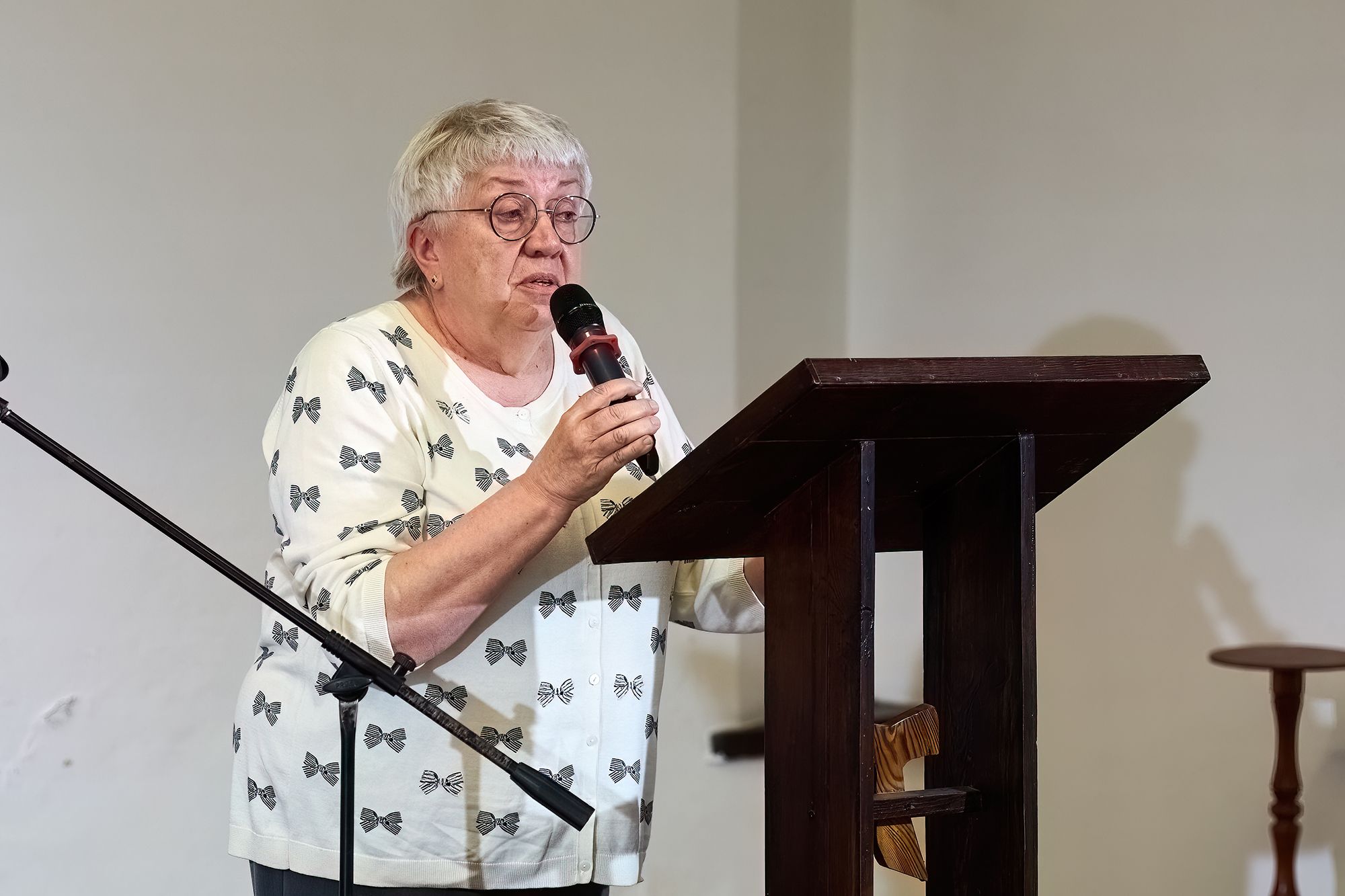
Why did the message of Divine Mercy emerge from Vilnius rather than from one of Europe’s great political or religious centers? This question was at the heart of a lecture delivered by Prof. Dr. Irena Vaišvilaitė during the VI World Apostolic Congress on Mercy, held in Vilnius on June 7–12.
Speaking to an international audience, the Lithuanian historian of art and Church history explored the historical and cultural circumstances that made Vilnius a unique setting for the revelations associated with St. Faustina Kowalska and the spread of the Divine Mercy devotion.
One of the central themes of her presentation was the seemingly unlikely places chosen for major spiritual events. Referring to well-known Marian and religious apparitions in Fatima, Lourdes, and Vilnius, Vaišvilaitė noted that those who received such revelations were typically humble, poor, and largely unknown to society.
“People who experienced these revelations were ordinary individuals whom no one knew,” she said. “It was often difficult for others to believe in the authenticity of their experiences and the message they carried.”
At the time of St. Faustina’s revelations, Vilnius was no longer the grand capital it had once been. Instead, it was a peripheral city marked by poverty, political uncertainty, and ethnic tensions. Yet despite these circumstances, the message of Divine Mercy continued to spread.
Vaišvilaitė also pointed to the symbolic elements commonly associated with revelations. In Lourdes, water became a central sign; in Fatima, the sun. In the image of Divine Mercy, the two rays of light symbolize the blood and water that flowed from Christ’s side.
“The grace of God is very humble,” she observed. “Perhaps that is why it came through such a humble city and such an ordinary person.”
The professor emphasized that Vilnius has long been a meeting place of different religious traditions. Over the centuries, Catholics, Orthodox Christians, Protestants, Jews, Karaites, and Tatars all lived in the city, creating a unique environment of cultural and religious diversity.
She also highlighted the significance of the Union of Brest in 1596, which brought part of the Orthodox community into communion with the Catholic Church and gave rise to the Greek Catholic (Uniate) Church. According to Vaišvilaitė, this historical experience remains relevant today as Christian communities continue to seek greater unity and dialogue.
The Divine Mercy message reached the future St. Faustina in interwar Vilnius—a city with a large Jewish population and a complex ethnic makeup. At a time of rising nationalism, both Lithuanians and Poles claimed the city as their own, while Europe moved steadily toward the catastrophe of World War II.
Vaišvilaitė suggested that it was no coincidence that the revelations took place during a period marked by national tensions and growing uncertainty about the future.
The decades that followed brought profound changes to Vilnius. The city’s Jewish community was nearly annihilated during the Holocaust, many Polish residents were forced to leave, and numerous churches and houses of worship were closed or repurposed under Soviet rule. Historic cemeteries were destroyed, and much of the city’s multicultural heritage was disrupted.
As a result, she argued, postwar Vilnius became, in many ways, a “city without memory.” New residents arriving from different parts of Lithuania and the Soviet Union inherited a city whose traditional social fabric had been deeply altered.
This experience was not unique to Vilnius. Much of Central and Eastern Europe underwent similar upheavals during the twentieth century. For that reason, Vaišvilaitė suggested that St. Faustina’s message was never intended for Vilnius alone—it was a message of mercy for an entire region scarred by conflict, violence, and displacement.
Concluding her lecture, she returned to the question posed in its title.
“So why did Vilnius become the City of Mercy?” she asked. “Perhaps because, at that moment in history, mercy was what we needed most.”
Prof. Dr. Irena Vaišvilaitė is a Lithuanian historian of art and Church history, diplomat, and professor at Vilnius University. She worked for the Lithuanian-language service of Vatican Radio from 1991 to 1998 and earned her doctorate in Church History from the Pontifical Gregorian University in Rome. She later served as Lithuania’s Ambassador to the Holy See and the Sovereign Order of Malta (2012–2017) and as the country’s Permanent Delegate to UNESCO (2017–2019). She is also the author of numerous books and scholarly studies on the Christian heritage of Vilnius.