Dear brothers and sisters,
Today we celebrate Divine Mercy Sunday - a day on which the full beauty and power of the mystery of Easter is revealed. The Resurrection is not only a joyful message about life after death. It is God’s response to human sin, to our weakness, to our wounds. It is the victory of Mercy.
In the Gospel, we see the disciples - gathered together behind locked doors. They are afraid. They are confused. Perhaps they feel guilty for having abandoned Jesus in His suffering. And it is precisely into this space of isolation, fear, and guilt that the Risen Christ comes. He does not remain outside the door, waiting for the disciples to perfect themselves. He comes to them as they are and says: “Peace be with you” (Jn 20:19).
The first word of Divine Mercy Sunday is peace. Not as an emotion, but as a gift. As forgiveness. As a new beginning.
Then Jesus shows them His hands and His side. He does not show His power, nor the external signs of His victory. He shows His wounds. This is very important. For it is precisely through those wounds that we recognize who He is.
The Apostle Thomas wants to touch those wounds. He seeks certainty. And when Jesus allows him to do so, Thomas pronounces one of the most beautiful professions of faith: “My Lord and my God!” (Jn 20:28).
Dear friends, this story is not only Thomas’s story. It is also our path. We too often seek certainty. We want to see, to touch, to be convinced. And Christ grants this to us - but not always in the way we expect.
Today we do not touch the body of Jesus as Thomas did. Yet we do touch His wounds in another way. We can touch the wounds of Christ when we encounter our suffering brothers and sisters. Every person who suffers, who is lonely, who is wounded, bears the wound of Christ. And when we lovingly touch that person’s pain, we recognize Christ alive among us.
This is the mystery of Mercy: God allows Himself to be recognized through wounds.
Here another dimension of the Gospel opens before us. Jesus not only forgives - He sends. “As the Father has sent me, so I send you” (Jn 20:21). Then He breathed on them and said: “Receive the Holy Spirit” (Jn 20:22).
Mercy is not only something we receive. Mercy is also something we are called to live. The Holy Spirit is given to us so that we may do what often seems humanly impossible: to forgive, to love, to begin anew.
In the first reading from the Acts of the Apostles, we see what a community looks like when it has received this gift. All the members of the community devote themselves to the apostles’ teaching, to fellowship, to the breaking of the bread, and to prayer. They share what they have. They live not for themselves, but for one another. They become a community that draws others (cf. Acts 2:42–47).
This is the first “City of Mercy.” It is made up not of buildings or structures, but of people who live differently - who look at one another not as competitors or strangers, but as brothers and sisters.
Today we are invited to continue building such a city: to build the City of Mercy in our families, in our parishes, in our workplaces, and in society.
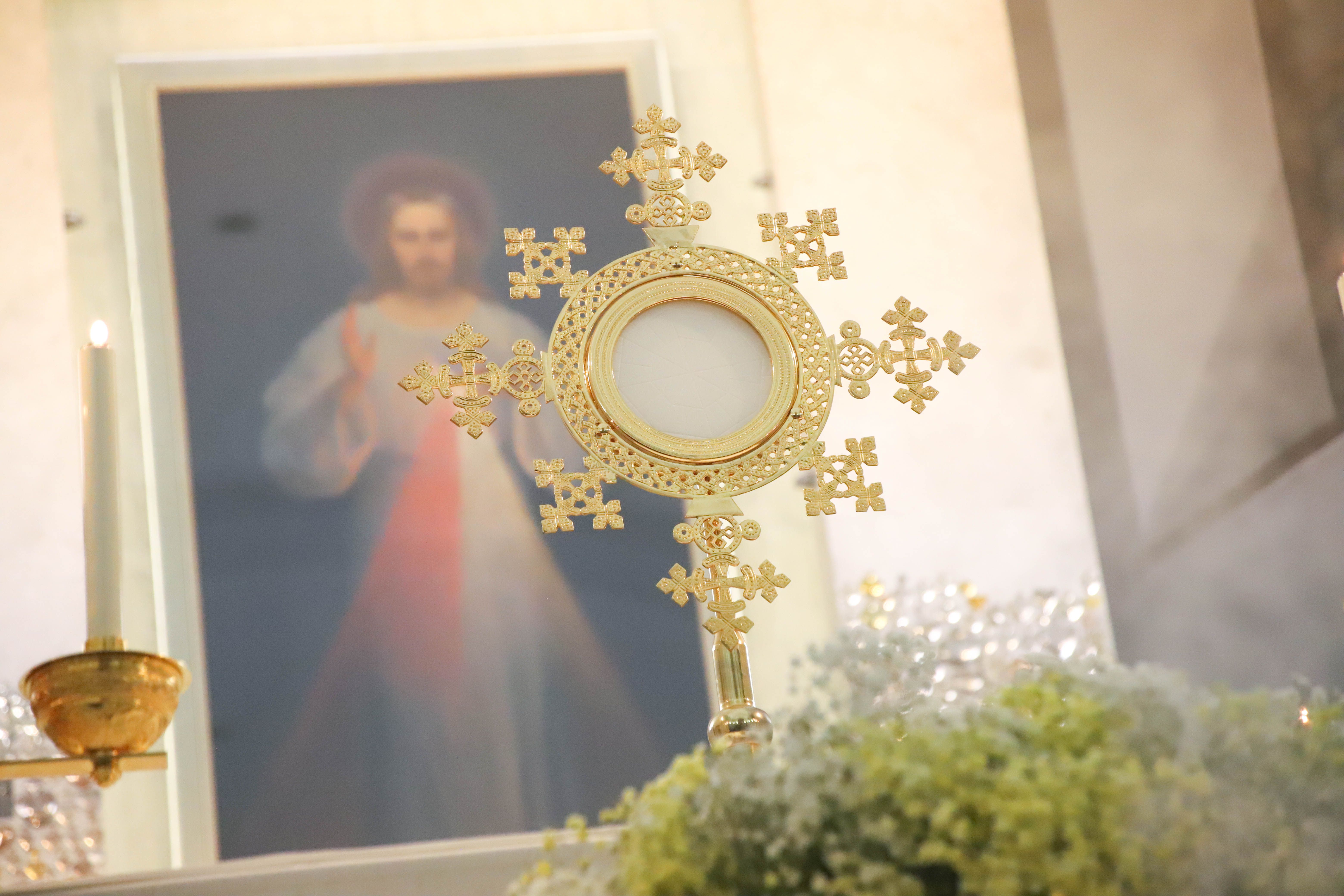
In this context, the Image of Divine Mercy becomes especially meaningful. In it we see Jesus, and from His side flow two rays. These are the same words of the Gospel, “Peace be with You”, transformed into an image. It is an invitation to trust: “Jesus, I trust in You.”
Trust is not weakness. It is the strength of faith - a decision to rely not on ourselves, but on God.
Dear brothers and sisters, today this message of Mercy resounds in a particular way here, in Vilnius. From this city, through St Faustina and bl. Michael Sopočko, it spread anew to the whole world. And today we are preparing for another important moment - the World Apostolic Congress on Mercy.
This is not simply an event. It is a call - a call not only to participate, but to bear witness; a call to be a Church that lives by Mercy.
Therefore, today I want to invite you very concretely: register through the website and come to Vilnius June 7-12 to take part in this congress. Come not as observers, but as witnesses. Come with faith, with your experience, and with a desire to help build the City of Mercy when you return home.
And - more importantly - let us begin preparing already now. How? Very simply, but very concretely.
Each day, let us perform at least one work of mercy:by action - helping someone in need;by word - consoling, encouraging, forgiving; and by prayer - remembering those who suffer.
It is not much. But if each one of us does this, not only our lives will begin to change, but also our surroundings. This is how the City of Mercy is built - not by great projects, but by small, faithful acts of love.
Today Christ comes into our lives. He comes through our locked doors. He says: “Peace be with you” (Jn 20:19). He shows His wounds. He calls us to believe. He gives us His Spirit. And He sends us.
Today, each one of us can say in our hearts with Thomas: “My Lord and my God” (Jn 20:28). May this faith become a way of life, as we recognize Christ in others, live mercy, and boldly witness to the world that: God is alive; God is merciful; and His faithful love endures forever.
Amen.