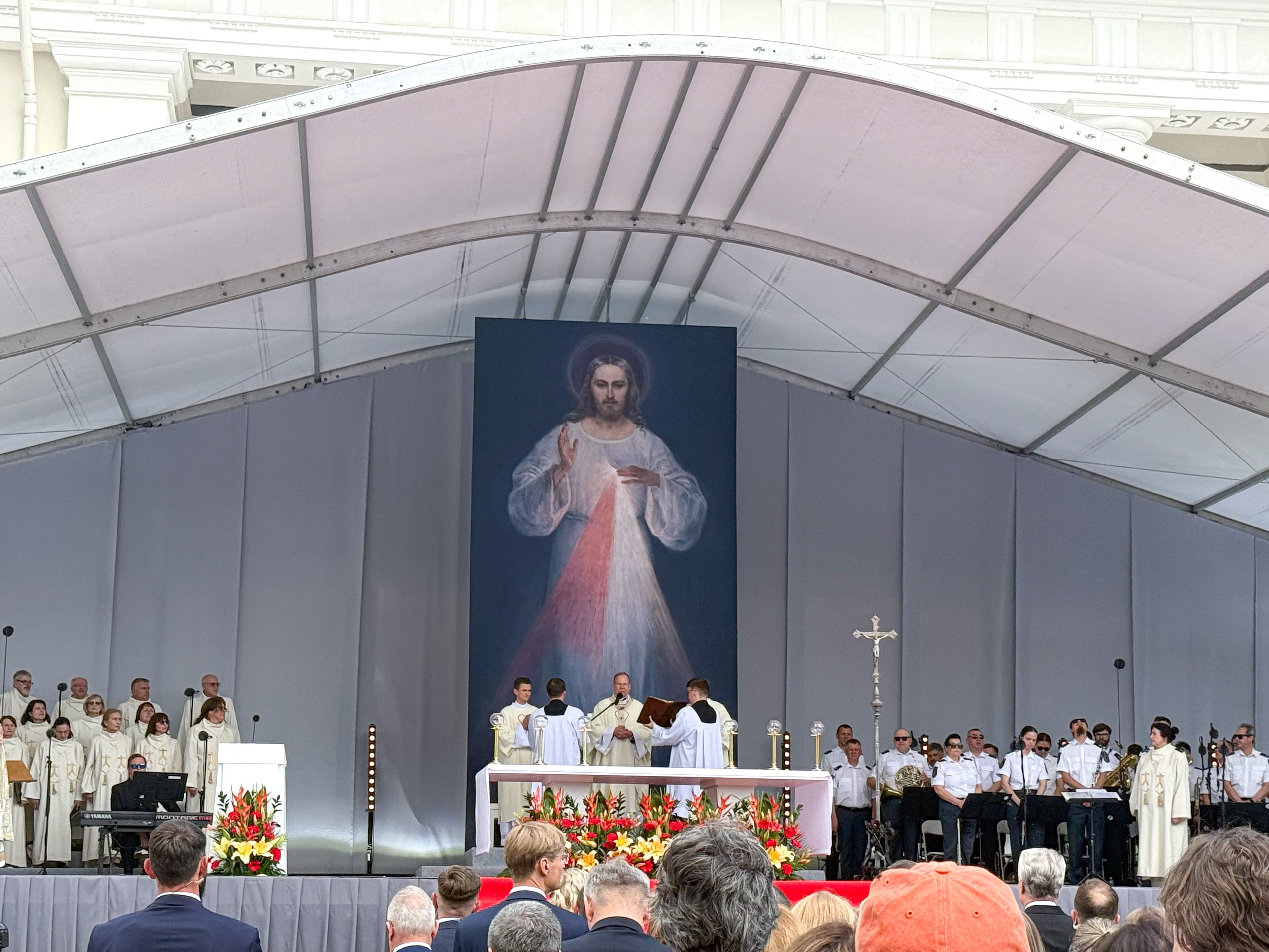
Dear participants in the Sixth World Apostolic Congress on Mercy,
Dear brothers and sisters in Christ,
Today, in the heart of Vilnius, the Sixth World Apostolic Congress on Mercy begins. It is no coincidence that it opens on the Solemnity of the Most Holy Body and Blood of Christ. The Eucharist is the very center of God’s Mercy. In the Eucharist, Christ does not merely speak about love. He gives Himself. He feeds, heals, and transforms His people.
Today, it is not an idea, a symbol, or an ancient religious tradition that will pass through the streets of Vilnius. Today, the living Christ Himself will walk through this city. The same Christ who, at the Last Supper, said: “This is my body, which is given for you” (Lk 22:19). The same Christ who carried His cross through the streets of Jerusalem. The same Christ who, after His Resurrection, showed His wounds to the Apostles (cf. Jn 20:24–29). The same Christ who revealed Himself in this city to Saint Faustina as the Lord of Mercy.
In today’s first reading, Moses reminds Israel of its journey through the desert. God’s people experienced hunger, thirst, and vulnerability so that they might learn that “man does not live by bread alone, but by every word that comes from the mouth of God” (Dt 8:3).
Our own age is experiencing a kind of desert. We possess immense technology, vast information, and unprecedented power. Yet we also encounter loneliness, anxiety, and a deep spiritual hunger.
In his encyclical Magnifica Humanitas, Pope Leo XIV writes: “The living God descends into our history in order to free us from all forms of slavery. He takes upon himself our weakness and transforms it into a setting for salvation” (Magnifica Humanitas, 232).
This is the meaning of Divine Mercy. God does not avoid our wounds. He enters into them. The wounds of Christ become the source of life. The Eucharist is therefore the sacrament of Mercy—not because it is received by perfect people, but because in it Christ feeds and transforms the weak, the weary, sinners, and seekers.
Saint Faustina recorded these words of Jesus in her Diary: “The more miserable a soul’s condition, the greater its right to My mercy” (Diary, 1182). The Eucharist is born on the night of betrayal. Saint Paul reminds us: “On the night when he was betrayed...” (1 Cor 11:23). It is precisely then that Christ gives Himself as the Bread of Life.
Today Saint Paul also tells us: “Because there is one bread, we who are many are one body” (1 Cor 10:17). The Eucharist does not nourish isolated individuals. It creates the Church. It gathers scattered people into one Body.
The theme of our Congress—“Building the City of Mercy”—is not primarily about buildings or structures. The true City of Mercy is built from people transformed by God’s love. Pope Leo XIV writes: “The Lord gives himself [in the Eucharist] and gathers the Church together, so that his offering becomes the principle of unity and source of new life” (Magnifica Humanitas, 234).
We do not merely receive the Eucharist. The Eucharist transforms us into what we receive. Christ builds Himself from us. He makes us His Body in the world. Therefore, it can truly be said: you are the City of Mercy. And today we will see this reality as we walk in Eucharistic procession through the streets of Vilnius.
As we journey through the city, we will stop at places that remind us of the wounds of this city, but also bear witness to healing.
The Cathedral was transformed during the Soviet era into a museum and concert hall. At one point, there were even plans to turn it into a tractor factory. Yet today Christ once again emerges from the Cathedral as the living Lord.Saints John’s Church stands within the university, where Marxist atheism was taught for many years. Where a world without God was once promoted, the Gospel is proclaimed once more.Saint Casimir’s Church was turned into a Museum of Atheism. Christ was driven out, yet He has returned.The Gates of Dawn were once threatened with demolition, yet this Shrine of the Mother of Mercy remained standing as a sign that God’s mercy cannot be destroyed.The Church of the Sacred Heart of Jesus on Rojaus Street was converted into a prison. Today, the principal venue of this Congress stands beside it.
Thus, this Eucharistic procession is more than a journey through a city. It is a journey through our history, through the wounds of a nation, and through our own personal wounds. And on this journey Christ walks with us. He walks to set the human heart free.
The Risen Christ remains marked by His wounds. Thomas recognizes Jesus precisely through those wounds (cf. Jn 20:24–29). Yet now they no longer signify death. They have become sources of life.Saint Faustina recorded these words of Jesus: “Mercy for souls flows from all My wounds as from a spring, but the wound in My Heart is the source of unfathomable mercy” (Diary, 1190). From the pierced Heart of Christ flow blood and water (cf. Jn 19:34). From there the Church is born. From there the sacraments flow. From there shine the rays of Divine Mercy.
Therefore, our mission is not merely to speak about mercy. Our vocation is to allow Mercy to become incarnate within us.dfSaint Faustina prayed: “I desire to be transformed completely into Your mercy and to be Your living reflection of You” (Diary, 163).
Dear brothers and sisters, after Mass we will enter into the Eucharistic procession. It is not a nostalgic remembrance of the past. It is Christ’s triumphal procession. It is a sign that the Risen Lord still walks with His people and remains present within His people today.
May the Christ whom we receive today in the Eucharist make each of us a living stone in the City of Mercy. May His mercy heal our wounds. May His Body transform our hearts. And may the world, looking upon the Church, recognize the living Face of Mercy.
Amen.