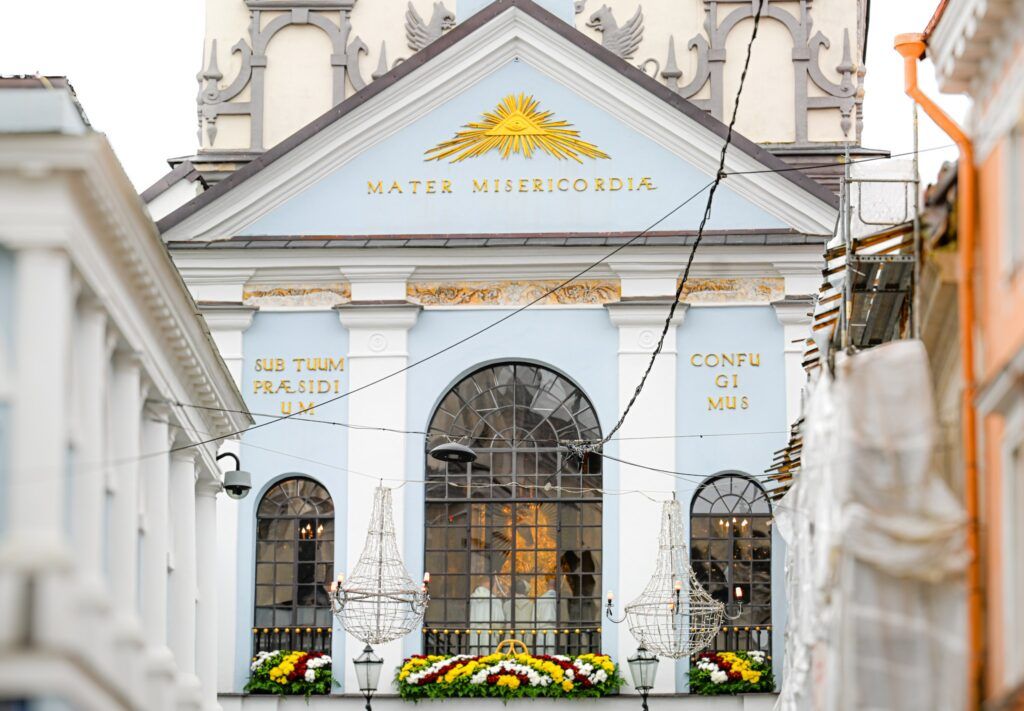
Photo by Aistė Karpytė
The Gates of Dawn are one of Vilnius’ most iconic landmarks, first mentioned in the 16th century as part of the city’s defensive walls. Of the ten original gates, these are the only ones that survived. In the chapel above the gate is the famous miraculous image of Our Lady of the Gate of Dawn, Mother of Mercy. The image has been venerated for centuries by Catholics, Orthodox Christians, and Eastern Rite Catholics. The Gates of Dawn stand not only as an architectural treasure, but also as a spiritual symbol of the city.
Every November, Vilnius celebrates the Feast of Our Lady of the Gate of Dawn, Mother of Mercy. For an entire week, the city becomes a living centre of prayer as believers gather to pray for families, young people, the sick, migrants, the military, and many others.
Fr. Mykolas Sotničenka, a resident priest at St. Teresa’s Parish, notes that the feast is not only about asking for graces. Above all, it is about recognizing them, “Mary is full of grace, that is, she reveals herself as the one who is full of grace. When Pope Francis visited Lithuania and the Gates of Dawn seven years ago, he said, ‘Look to this Mother; she is called the Mother of Mercy for a reason.’ And he asked, ‘Where is the child? You carry the child in your heart’. So let us see that we are already created in God’s image and already carry Jesus within our hearts.
The purpose of this feast, then, is to recognize the graces we already have, to live by them, and to share them with others. We often fall into the habit of asking for more and more. But we are already blessed. We simply need to notice it. And together, to build a City of Mercy.”
Vilnius: the City of Mercy
From June 7 to 12, 2026, Vilnius will become the world’s “Capital of Mercy” as it hosts the World Apostolic Congress on Mercy. The city’s identity as the City of Mercy is rooted in the mission carried out here by St. Faustina Kowalska and Blessed Fr. Michał Sopoćko, to whom the Lord entrusted the message of Divine Mercy. Because of them, the first image of the Divine Mercy was painted in Vilnius, the Feast of Divine Mercy was celebrated here for the first time, and the Chaplet of Divine Mercy was revealed here as well. Yet the story of Vilnius as a City of Mercy began even earlier, and it centred around the Mother of Mercy at the Gates of Dawn.
The Gates of Dawn can be seen as a kind of spiritual birthplace of mercy. In the same way, this year’s feast can be seen as the “birthplace” of the upcoming congress. “It’s important to understand that the congress is not about promoting a cult of mercy, even though devotion to Divine Mercy spread through St. Faustina and Blessed Fr. Sopoćko, and much of it began right here in Vilnius. The congress invites each of us to become a ‘brick of mercy,’ to show mercy to one another in our daily lives: at home, in our communities, in our families. This is how we build the City of Mercy.
You might say that the gate with the image of the Mother of Mercy symbolically obliges the city to be the capital of mercy. As you walk through the gate, the Mother of Mercy welcomes you and accompanies you. She looks upon you with mercy and calls you to share that mercy with others. And when you leave the city through the gate, heading into a world that can be harsh and unfamiliar, what message do you carry with you? As an ambassador of the City of Mercy, you bring mercy wherever you go. You show it to others. And that is a great responsibility: not simply to be devout, but to be merciful,” says Fr. Sotničenka.
The Gates of Dawn and their annual feast remind us that mercy is not just a word or an emotion. It is an action. Everyone who passes through the Gates of Dawn is invited to become part of the City of Mercy: a living “brick of mercy” in their own surroundings.